
xR: Expected Retention as a Foundational Metric for Possession Survival in Football

Quantitative analysis in football has advanced through the formalization of probabilistic metrics that map individual actions to future outcomes. Expected goals and expected threat have redefined how shooting and progression are evaluated. However, the ability of a team to sustain possession under pressure remains insufficiently isolated as a primary analytical object. This work introduces Expected Retention (xR), a probabilistic metric that estimates the likelihood that a given action preserves possession without degrading the offensive state. The proposal reframes retention not as an intermediate constraint within value models, but as an explicit outcome. By combining tracking and event data, xR captures the latent capacity of players to absorb pressure and maintain structural integrity. The article develops the conceptual basis of the metric, formalizes the definition of useful possession, and situates xR within the broader landscape of football analytics.
1. Introduction
Modern football analytics has largely focused on outcomes that are either terminal or directional. Expected goals quantify the probability that a shot results in a goal. Expected assists and related metrics evaluate the contribution of passes to shot creation. Expected threat and similar frameworks attempt to measure the long term value of ball progression across the pitch. These models share a common structure in which the value of an action is derived from its relationship to future scoring events.
This paradigm has produced substantial advances, yet it leaves a critical aspect of the game underexplored. Before a team can progress or create, it must first survive. The capacity to maintain possession, particularly under pressure, is a prerequisite for all subsequent value generation. Despite this, possession retention is typically treated as a binary outcome or as a secondary factor embedded within broader valuation models.
The absence of a dedicated probabilistic framework for retention creates a blind spot. Players who consistently stabilize possession in adverse conditions may not register strongly in metrics that prioritize progression or chance creation. Conversely, players who operate in low pressure environments may appear efficient without demonstrating the underlying skill required to sustain possession against strong defensive structures.
This work proposes Expected Retention as a foundational metric that addresses this gap. By defining retention as a probabilistic outcome conditioned on context, xR provides a lens through which the survival of possession can be analyzed independently from progression.
Robustness Checks
The model maintains consistent performance across temporal splits, with AUC ranging between 0.88 and 0.91 and Brier scores remaining stable across training and test sets. Decile monotonicity is preserved out-of-sample, although with some degradation in the test set, indicating that the ranking signal remains intact even under distribution shift.
Cross-competition evaluation further supports the structural validity of the model.
When trained on league data and tested on cup competitions, the model retains strong discriminative ability (AUC > 0.93), suggesting that it captures general properties of possession dynamics. However, calibration errors increase under distribution shift, highlighting the need for context-specific recalibration when transferring across competitions.
Overall, these results indicate that xR behaves as a robust ranking model of possession survival, even if its probabilistic calibration is sensitive to contextual variation.
2. Conceptual Motivation
The game of football can be interpreted as a sequence of state transitions. Each action transforms the configuration of players, the location of the ball, and the distribution of control across the pitch. Traditional metrics evaluate the desirability of these transitions based on their proximity to scoring events or territorial gain. However, not all valuable actions move the team closer to goal. Some actions serve to prevent collapse.
Consider a central midfielder receiving the ball with multiple opponents in close proximity. The immediate objective is not necessarily to advance the ball, but to avoid losing it in a dangerous zone. A successful action in this context may simply consist of controlling the ball and transferring it to a teammate while preserving the structural coherence of the team. Such actions are essential to high level play, yet they remain weakly represented in existing models.
The core insight behind xR is that retention under pressure constitutes a measurable skill. It reflects perception, technical execution, spatial awareness, and decision making. Importantly, it is context dependent. Retaining possession in a low pressure situation carries limited informational value, whereas doing so in a highly constrained environment reveals a significant capability.
By modeling retention as a probability, xR aligns this aspect of play with the broader probabilistic framework that underpins modern analytics. It allows analysts to quantify how difficult a given action is in terms of survival and how effectively players perform relative to that difficulty.
3. Defining Useful Possession
A central challenge in formalizing xR lies in the definition of what constitutes successful retention. A naive definition would equate success with the mere continuation of possession. Such a definition is insufficient, as it fails to distinguish between actions that preserve value and those that degrade the offensive state while technically maintaining control of the ball.
To address this, the notion of useful possession is introduced. An action results in useful possession if two conditions are satisfied within a defined horizon. First, the team must retain the ball. Second, the offensive state must not deteriorate beyond an acceptable threshold.
The offensive state can be represented as a function that aggregates multiple components. Expected threat provides a measure of territorial value. Spatial control, derived from tracking data, captures the extent to which a team dominates key areas of the pitch. Additional elements may include the availability of forward passing options and the degree of numerical or positional superiority in relevant zones.
Formally, let the state of the game at time t be denoted by a scalar or vector representation that encodes these features. An action is considered to preserve useful possession if, after a sequence of subsequent actions or a fixed time interval, the team remains in possession and the state has not declined beyond a specified tolerance. This tolerance accounts for minor fluctuations that do not materially affect the team’s capacity to progress.
This definition introduces a crucial distinction. Retention is not binary, but conditional on maintaining the potential for future value generation. It therefore integrates both survival and structural preservation.

where:

4. Formal Definition of Expected Retention
Given the definition of useful possession, Expected Retention can be expressed as the conditional probability that an action leads to such an outcome. For each action, the model estimates the likelihood that the team will retain possession in a useful state over the chosen horizon.
This probability is conditioned on a set of contextual variables derived from both event and tracking data. These variables include, but are not limited to, the distance and orientation of nearby defenders, the velocity of closing opponents, the density of players in the vicinity of the ball, and the spatial configuration of teammates. Additional features may capture the orientation of the receiving player, the angle of the incoming pass, and the accessibility of subsequent passing lanes.
The model thus learns a mapping from high dimensional contextual information to a probability of survival. Actions that occur under intense pressure and constrained spatial conditions will typically have lower expected retention values. Actions in open space will exhibit higher values, reflecting the relative ease of maintaining possession.
By construction, xR provides a baseline expectation for each action. This baseline can be compared to the observed outcome to assess performance. The difference between actual retention and expected retention yields a measure of overperformance or underperformance, which can be aggregated at the player or team level.

5. Relationship to Existing Metrics
Expected Retention occupies a distinct position within the ecosystem of football metrics. While it shares the probabilistic structure of expected goals and expected threat, its objective variable is fundamentally different.
Metrics such as expected threat evaluate the potential for future scoring based on ball location and movement. They implicitly incorporate the risk of losing possession, as transitions to states without possession carry zero or negative value. However, this incorporation is indirect. The models do not explicitly estimate the probability of retention as a standalone quantity.
Similarly, action valuation frameworks compute the expected change in scoring probability associated with each action. These frameworks account for both positive and negative outcomes, including turnovers. Yet again, retention is embedded within a broader value calculation rather than isolated.
Expected Retention separates this dimension from others. It allows analysts to examine survival independently from progression and creation. This separation is analytically valuable because it reveals trade offs that are otherwise obscured. A player may contribute positively to progression while performing poorly in retention, or vice versa. Without a dedicated metric, these profiles are difficult to disentangle.
6. Interpretability and Tactical Relevance
One of the strengths of xR lies in its interpretability. The metric can be communicated in intuitive probabilistic terms. For a given action, one can state that under the observed conditions, there is a certain probability that the team will maintain possession in a useful state. This interpretation is accessible to practitioners, including coaches and players, who may not engage directly with the underlying model.
From a tactical perspective, xR provides insight into how teams manage pressure. It highlights zones of the pitch where retention is particularly challenging and identifies players who excel in these contexts. It also enables the analysis of team structures, as certain positional arrangements may facilitate higher retention probabilities by offering more accessible passing options or better spatial coverage.
Furthermore, xR can inform decision making. Players who consistently choose actions with high expected retention may contribute to stability but limit progression. Players who operate in low xR contexts and succeed may offer a different form of value by enabling the team to bypass pressure. The balance between these tendencies is a central tactical consideration.
7. Methodological Considerations
The construction of an xR model raises several methodological issues. The first concerns the choice of horizon over which retention is evaluated. A short horizon captures immediate survival but may miss delayed consequences. A longer horizon introduces additional noise and dependencies. The selection of this parameter should reflect the temporal dynamics of possession sequences and may vary depending on the analytical objective.
A second issue relates to the definition of the offensive state. While expected threat provides a convenient scalar representation, it does not fully capture the richness of the game. Incorporating spatial control and other features increases fidelity but also complexity. The trade off between interpretability and completeness must be managed carefully.
A third consideration involves model specification. The high dimensional nature of tracking data suggests the use of flexible models capable of capturing nonlinear interactions. However, such models may reduce transparency. Ensuring that the resulting probabilities are stable and well calibrated is essential for practical use.

8. Limitations and Critiques
The introduction of xR does not eliminate the challenges inherent in modeling football. The metric depends on the quality and resolution of tracking data, which may vary across competitions. Errors in player positioning or identification can propagate through the model and affect estimates.
The definition of useful possession, while principled, remains a modeling choice. Different definitions may yield different results, and there is no single canonical formulation. Empirical validation is therefore necessary to assess which variants align best with observed outcomes and expert judgment.
Another limitation concerns the interaction between retention and progression. While xR isolates survival, football actions often involve a trade off between maintaining possession and advancing the ball. Evaluating players requires integrating xR with other metrics rather than considering it in isolation.
9. Implications for Analysis and Scouting
Despite these limitations, Expected Retention offers a new dimension for analysis. It enables the identification of players who contribute to possession stability in ways that are not captured by existing metrics. This is particularly relevant for roles such as central midfielders and defenders involved in build up phases.
In scouting, xR can help distinguish between players who operate in different contexts. A player with high raw retention rates in a low pressure environment may appear reliable but may not possess the skills required to perform under more demanding conditions. By conditioning on context, xR provides a more nuanced evaluation.
At the team level, the metric can be used to assess how well a team copes with pressing opponents. It can reveal structural weaknesses, such as the absence of viable passing options in certain zones, and inform tactical adjustments.

10.1 The structural limitation of xR
The empirical evidence makes this clear:
xR increases monotonically with retention
xR decreases under pressure
xR remains largely orthogonal to value creation (xT)
This becomes explicit when placing actions in the joint space of xR and xT:

High xR actions cluster around low or even negative xT changes. In other words, the safest actions are often those that do not improve the attacking state. The model is therefore implicitly rewarding conservatism.
This is not a failure. It is a consequence of the objective function.
Formally, xR is estimating:

But the real objective of decision-making in football is closer to:

Where state value includes both control and threat.
10.2 From survival to decision-making
To move from control to decision quality, actions must be evaluated as a trade-off between three components:
Survival — probability of maintaining possession (xR)
Reward — how much value the action generates if successful (ΔxT)
Cost — how harmful the action is if it fails (contextual risk)
This leads to a composite formulation:

Where:
xR(a) acts as a gating probability
ΔxT(a) captures immediate progression
Risk(a) is approximated through pressure and positional context
λ controls the penalty for failure
This is no longer a control model. It is an approximation of expected net value.
10.3 Practical implementation
In practice, the raw components operate on very different scales:
ΔxT is typically small (centésimas)
Risk proxies (e.g. pressure) are larger and more variable
To avoid the model being dominated by the cost term, both components are rescaled:
# Scale components to comparable magnitudedf["dxT_scaled"] = df["dxT"] / df["dxT"].abs().mean()df["risk_scaled"] = df["risk_proxy"] / df["risk_proxy"].mean()# Composite scoredf["composite_score"] = ( df["xR"] * df["dxT_scaled"] - (1 - df["xR"]) * lambda_risk * df["risk_scaled"])This ensures that the model reflects relative trade-offs, not arbitrary unit differences.
10.4 From actions to distributions
Once defined, the composite score can be evaluated across deciles, in the same way as xR:
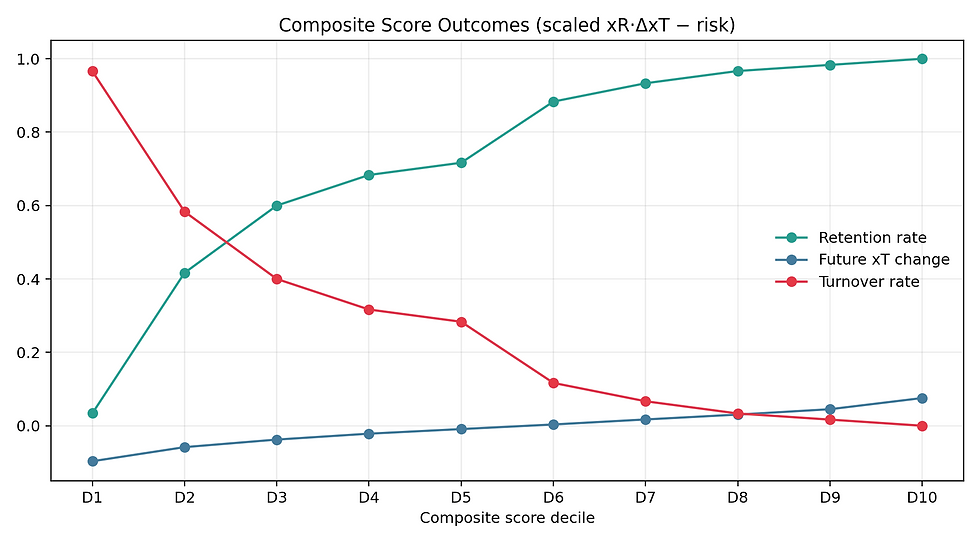
The structure changes meaningfully:
Retention still increases, but no longer dominates
Turnovers decrease, but not as the sole signal
Most importantly, future xT becomes clearly positive in higher deciles
This is the key transition:
xR separates actions by safetyComposite separates actions by decision quality
10.5 The role of context
Even with a well-balanced formulation, raw scores remain sensitive to environment:
Players operating under high pressure accumulate more risk
Players receiving in advanced zones have different reward distributions
A raw composite leaderboard therefore mixes:
decision-making quality
contextual difficulty
To isolate the former, the score must be normalized by context.
10.6 Context-adjusted decision value
The final step is to center the composite score relative to its expected value given context:

In practice:
pressure is bucketed
pitch is discretized into zones
expectations are computed within each context group
This transforms the metric into:
Performance relative to what the game state allows.
10.7 Player-level interpretation
Aggregating this context-adjusted score at player level yields a fundamentally different view:

Now:
Values are centered around zero
Positive players outperform their context
Negative players underperform their context
Pressure no longer dominates interpretation
This is the crucial distinction:
Raw metrics describe what happened
Context-adjusted metrics describe how well it was done
10.8 What this changes
This framework resolves the central limitation identified earlier.
Previously:
The model rewarded safe circulation
High xR actions were often low-value
Now:
Safe actions are only rewarded if they justify their lack of progression
Risky actions are only penalized if they are not compensated by value
The model explicitly encodes the fundamental trade-off of football:
When is it worth taking risk?
10.9 Interpretation boundaries
This is still not a full state-value model.
It does not yet:
model future states explicitly (no full MDP)
simulate opponent transitions after loss
capture long-term sequence effects
However, it approximates the decision problem at the action level with sufficient fidelity to:
rank actions meaningfully
compare players under context
identify stylistic differences in decision-making
10.10 Closing the loop
The progression is now complete:
xR defines how likely a state survives
xT defines how valuable a state becomes
Composite defines whether a decision is worth it
This is the minimal structure required to move from describing football actions to evaluating football decisions under uncertainty.
11. Conclusion
Expected Retention reframes a fundamental aspect of football as a probabilistic outcome. By isolating the likelihood that an action preserves possession in a useful state, it complements existing metrics that focus on progression and scoring. The concept introduces a new analytical axis that captures the capacity to survive under pressure, a skill that is essential yet underrepresented in current models.
The development of xR opens several avenues for further work. These include the refinement of the definition of useful possession, the integration of richer representations of game state, and the empirical validation of the metric across different contexts. As with previous advances in football analytics, the ultimate value of xR will depend on its ability to provide insights that align with the realities of the game and to support better decision making in practice.


Comments